

Veronica Mars Saison 4 Episode 2
Mars, which is the fourth planet from the sun and the third smallest in size, got its proper name because of its rusty ruddy color. People associated the planet's ruddy color with state of war, then they named information technology Mars, afterwards the Roman god of war. There's a simple explanation for Mars'due south red colour: its soil contains iron oxide, better known as rust.
No other planets in our solar system has caused as much speculation every bit this ruby-red dot in the night sky. Among the reasons for all the speculation are the dark and light features on Mars that can exist seen using only a medium-size telescope. And, with skilful viewing conditions, you tin can see that Mars has light scarlet areas and darker areas that seem to be connected in some way. Also, polar ice caps come and become with Mars'southward seasons.
Mars has two very small moons, Phobos and Demos, which are named for the horses that pulled the Roman god's chariot. These moons were probably asteroids captured by the planet's gravitational pull when they came also close to Mars.
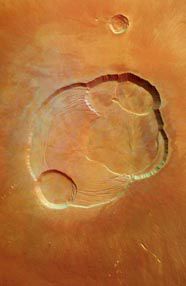
Photo courtesy of NASA
The journeying from Earth to Mars takes about six months. The Martian day is about the same length as an Earth twenty-four hours. Its year is 687 Earth days. And the surface is very dusty. In fact, occasional loftier winds tin cause dust storms so large, they can encompass the whole planet.
Mars has many interesting features on its surface, including the largest volcano in the solar system, Olympus Mons. It is and so large, information technology dwarfs Mount Everest here on Earth. Thankfully, Olympus Mons is inactive. Mars'due south Valles Marineris canyon is eleven times longer and four times deeper than the Grand Canyon in Arizona. All of this, and much more, makes up a planet near one-half the size of Earth.
For centuries, people have discussed whether or not there is life on Mars. Since it is then close to World, mayhap the climate would be liveable. Maybe some of the lines that tin be seen on its surface are really rivers of water, which is necessary for life. But on July 4, 1997, the NASA Pathfinder rover landed on Mars. It carried a smaller robotic rover called Sojourner that roamed the planet, sending back incredible pictures of the surface of Mars. The Mars spacecraft visitors tested the soil in search of signs of life and establish none.
But the scientific information did not settle the age-old debate, and many theories, pro and con, still exist. For example: The lack of life found past Sojourner only shows there was no life specific to the site of the robot. Because of Mars's many dormant volcanoes, some astronomers think that when they were active, lava and steam poured from them. When the steam cooled, it fell equally rain, feeding rivers. (It is thought that large, moving rivers one time crossed the surface of Mars.) On World, life-forms be in water, then, at one time, life may have existed in the Martian rivers.
Still other scientists call back there is no life on Mars because the planet has no liquid water today. Water seems to exist at that place but as ice, in the polar ice caps and perchance nether the Martian soil. As well, the Martian atmosphere is very thin, causing temperatures on Mars to average well below zero. Inhospitable winds rage beyond the surface at very loftier speeds. Information technology does not offer a friendly environment in which to live.
Then, on January 4, and January 25, 2004, NASA's twin exploration rovers landed on Mars, serving every bit robotic geologists. They continued NASA'southward search for signs of life, sending back daily images from the panoramic cameras they each carried. The rovers (named Spirit and Opportunity) landed at different places, enabling them to use their special instruments to take soil samples from ii areas. Their payloads, which likewise showed no signs of life, oasis't really settled the debate over life on Mars, but the information and images they relayed brand the conversations much more colorful.
Source: https://science.howstuffworks.com/46002-mars-explained.htm
Posted by: piersonrund1961.blogspot.com
0 Response to "Veronica Mars Saison 4 Episode 2"
Post a Comment